12 November 2025

I - a straightener a la Collins

 I recently started Billy Collins' Horoscopes for the Dead. It has been on my TBR list since 2021! I don't remember why or what prompted it to be on the list. But should I be asked to hazard a guess, it would be my roughly semi-annual urge to appreciate, understand or at least read English poetry.

The Romantics and the Ballads are fine, but it’s free verse that I normally struggle with. Poetry by and large has been absent from my reading this year. I think the only one I read was वर्जिन: काव्य संग्रह, which, while Hindi was in Free Verse and more akin to the Modern English poetry rather than the Dinkars, Gupts and the other Rashtrakavis I hold in regard. Now that I look at Goodreads, the last poetry book before that was मधुशाला which I read in 2024. I started reading both these years ago but managed to finish them when I did only. But indeed Bachanji was a treat, to be savoured like expensive wine. 

भावुकता अंगूर लता से खींच कल्पना की हाला,

कवि साकी बनकर आया है भरकर कविता का प्याला,

कभी न कण-भर खाली होगा लाख पिएँ, दो लाख पिएँ!

पाठकगण हैं पीनेवाले, पुस्तक मेरी मधुशाला।

He is said to have written it before he started drinking. I may not have the "लोहू में है पचहत्तर प्रतिशत हाला" (seventy-five percent alcohol in my blood), still, I would use the "पाठकगण हैं पीनेवाले" (readers are the drinkers) as the basis to defend my right to employ the wine metaphor.

Anyway, the goal was to read more poetry. And so I am.

Billy Collins is the sort of poet I don't normally get. He writes like one speaks, no rhymes, no metre (or at least the one whose cadence is less noticeable). No heavy use of alterations. But this everyday speech flow and the poetry grounded in everyday life are what made it more palatable. After reading this, should one be disapointed at the lack of vakchautya, he will at least not be completely lacking in what happened. The hidden कवि कहना चाहता है कि may be not so hidden, but that's charming in its own way. This book is a bit soothing even when grief is a major theme.

Anyway, this is not supposed to be a prescription of what I like in poetry. I just happened to resonate with one of the poems. 'The Straightener', which can be read here (I myself am unclear of the legality of hosting a poem from a book in a personal blog as she did, but whatever).  


I love to organise my desk in my office. Some piles are arranged by thickness, but by width, and some by colour. The piles themselves are organized by utility. I just love to do it. No, I just love to complete this, to overcome the inertia is much hard. But once I start, its just peace. Once in a while, I will reorganise DD's desk too. It feels like Shramdaan, Karmdaan, Kaarseva. The peaceful feeling while organizing is there too when I do it for myself only. I remember during class 10 matrix exams making timetables and stuff meticulously. Tracking down every 15 minute chunk, with many chunks reserved for tracking itself!That were the days indeed. Anyway, back to the poem. 

Never tomahawk, lantern, and spyglass.
Always lantern, spyglass, tomahawk.

Yes indeed. Once decided, things are set in stone. I can be the greatest Lakir ka Fakir at times. I love self imposed rules. If I had some legal background, I could feature among the absurd anecdotes in Restart: The Last Chance for the Indian Economy (my GR review here). But actual babudom is torture to me. Foucaultian-poststructuralist-imposed-structural-violence should I refer to Akhil Gupta's Red Tape: Bureaucracy, Structural Violence, and Poverty in India (the book unirnoncally uses the terms, more can be read in my GR review here). The view is supported by the "I" in the poem too it seems:

And if I can avoid doing my taxes

Only if we all could do so, I am not an anarchist. I once read (and did a GR review of) von Mises' Bureaucracy. I agree a lot with him, self imposed rules are not the same as those imposed by the punitive backing of the state. I am currently reading The Bureaucratic Phenomenon which seems to diagree with this view of Mises, but I am yet to see his complete thesis and have just started it.  But at the very least i am no anarchists, I am for a strong state but at the same time hate the Babudom to its core. I don't know what I I am exactly, I feel a bit like the protagonist in English, August: An Indian Story. I feel like him in a lot many ways and I think I will pen down those thoughts once in a while. That I must do, but I must write a thousand other things. But this is somewhat more serious and personal than others. 


Sociology and fictional IAS babus aside. Back to the poem. The "I" in the poem too must feel the same tranquillity that the I do in real life. He too shirks social and legal obligation and prefers to straighten things out. The "I " has 

a note from a girl I was fond of.


As did I! It was a note saying we shall study Topology after we have lunch (separately). She planned things with me in writing! It was on my table for many months.  DD discovered it once and had a lot of fun teasing me. Good for her, I give her much pain, she can use this distraction. I have given over that girl now, but did the "I" in the poem ever express his feelings? Or perhaps he already did and it was reciprocated, and the note was a witness of that hence kept on the table as a trophy. Or maybe it was just an innocent note like in my case, kept as a reminder that he must act or perhaps a memoto. We will never know, but I hope the best for the "I" in the poem. He seems to be doing well. In fact:

Today, for example, I will devote my time
to lining up my shoes in the closet,
pair by pair in chronological order

and lining up my shirts on the rack by color
to put off having to tell you, dear,
what I really think and what I now am bound to do.

The rhythm of "tell you, dear ... what I now am bound to do" sounds so much better than it would have without the "dear." I don't know if there is a technical word for that, but perhaps it's not important. I can just enjoy it as it is. Maybe. The itch to know is too strong. Straighten, I must. But perhaps now. I will keep some things absolutely straightened out, and some will be the most convoluted. Like my thoughts, like this very post. I don't know perhaps it is that I can't tame my thoughts that I cut off artificial physical sacred zones that must be straightened out? Okay, no more pop self Freudian (?) diagnosis. Off (to straightening out my desk). 

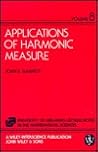
Review: Applications of Harmonic Measure (The University of Arkansas Lecture Notes in the Mathematical Sciences)

Applications of Harmonic Measure (The University of Arkansas Lecture Notes in the Mathematical Sciences) Applications of Harmonic Measure (The University of Arkansas Lecture Notes in the Mathematical Sciences) by John B. Garnett
My rating: 3 of 5 stars

Typesetting of the book is more of 70s Soviet Russia rather than the first world of the 80s. As clearly indicated in the title, the book is not about Harmonic measures but rather their applications. Still, it is one of the better introductions to them, perhaps only Conformal Invariants: Topics in Geometric Function Theory was a better book explaining them when it was written (and which, to be fair, I only discovered for Garnett cites them here). Only Krantz's The Theory and Practice of Conformal Geometry beats both of them. Garnett's own Harmonic Measure couauther many years later is not good either.

The approach is purely deterministic, but a small introduction is made to the probabilistic approach and references are provided should one be interested. The applications are interesting, but in case they are in Krantz's or Ahlfors' books, the exposition there is better. Still, a many of the applications first (and in a couple of cases only time) appeared in monograph form here and as such the book has its value.

View all my reviews

Review: Theory of $H^P$ spaces

Theory of H[superscript p] spaces Theory of H[superscript p] spaces by Unknown Author
My rating: 2 of 5 stars

This book is cited as the only other (non-probabilistic) proof of Hall's Lemma from his 1937 paper. It was also perhaps the first book to contain Carleson's proof of the Corona Conjecture. The book however is very lax in places, harmonic measures are not even defined explicitly. It makes no use of Distribution theory and Greens' Function is treated like an actual function.


For Carleson's Proof, one should instead refer to Garnett's Bounded Analytic FunctionsBounded Analytic Functions. He follows the latter approach of Carleson and ditched harmonic measure for an alternative proof from the lecture in Proceedings of the 15th Scandinavian Congress, Oslo, 1968. Garnett have two books on harmoic measures- Applications of Harmonic Measure (The University of Arkansas Lecture Notes in the Mathematical Sciences) and Harmonic Measure , but both are lacking the Hall's Lemma. As for the other content in the book, Introduction to Hp Spaces and Banach Spaces Of Analytic Functions have much better exposition.

View all my reviews

09 November 2025

Makers of Modern Dalit History: Further Thoughts (2/2)

 Earlier I wrote my initial thoughts on the book.  Earlier I had read only the Introduction and the chapter on the first maker Ayyankali. Now I have read about Babu Jagjivan Ram, Dakshyani Velayudjan, Gurram Jashuva, Guru Raidas, Sant Kabir, Kanshiram, President KR Narayanan, Sant Nandanar, Jhalkaribai, Jigendranath Mondal, Adikavi Valmiki, Ved Vyas. Who remains are Sant Janabai, Phule, Soyarbai, Saheed Udham Singh and Babasaheb. There is also a 20 page conclusion which I cheaters ahead and have already read. 

The initial impressions of being a non scholarly work is further cemented. I might have not even heard about many of them, but could not see the complete lack of any sort of negative feedbacks on the more recent political figures like Kanshiram and Narayanan. 

One will never get to know that this is the Kanshiram of मिले मुलायम कांशीराम, हवा उड़ गए जयश्री राम fame. It is not merely that Guru Prakash is not showcasing his pro-BJP bias he holds as a spokesperson of the party elsewhere, the thing is that even the most neutral observer will have to accept that this slogan is a defining moment for Kanshiram. Hiding this is not the truth, it is white washing (or Saffron coating as some of Kanshiram's most hardcore and fanatic followers may argue) of history. This does not benefit anyone. This does not suit anyone. This is just plain disrespectful to the reader. This is just, bad. Too many examples of this in the book, and that too from the limited ones I know. I am afraid what unknown unknowns are out there. I really wanted to learn of Babu Jagjivan Ram. He is indeed much undercredited, his caste was perhaps a big reason for that. Emergency (2025) (my review here) made him a cartoon villain. But the authors made him a saint. The truth is for no one it seems. The other most glaring omission is that when President Narayanan gave an award to Ang San Sui Kuu when the relationship with the Military Regime in Myanmar were excellent and it caused an diplomatic spat resulting in suspension of joint anti terror operations. One may argue (and in my view naievly, but still can't) that this is an example of his idealism, him being a working president and commitment to compassion all of which have been argued in the book but without any example to show us. Talk of don't show, tell. Or perhaps the fact that he had a Myanmari wife could have been mentioned as that may have influenced his actions. But, alas, the authors have no time for such critical thinking. As they don't have the same for editing or a second reading. There are still random bits and bots about completely unrelated things in many a biographies. And chronological order is still amiss. They love to randomly insert tangentially related Swami Vivekanand quotes (Theu have got the complete works and now must justify costs it seems). The only good is that they finally managed to cite Badri Narayan (in relation to Kanshiram). The choice of people is also very confusing. Why Ved Vyas or Valmiki are here, I have no idea. I have not read the chapter on Saheed Udham Singh but am prettty sure the being Dalit is not the main market of identity for him.

And then comes the conclusion. Oh boy. I should have started with the conclusion to see how bad the book actually is. It ends with a 4 point life lesson !!!! Clearly I can only take life lessons from a book only if the authors make a 4 point summary of such. There are also further some more biographies of contempt Dalit leaders. Here too, Bahin Mayawati is not to be found nut you can find Meira Kumar. The nepo daughter of Dy PM is clearly more inspiring than a nothing to CM Kumari Mayawati story. Perhaps the only part where I can feel that the political leaning may have affected it. Meira Kumar is a non factor, but Mayawati is a sleeping elephant. And if you aren't the Mahawat, don't let people like the elephant.

 Anyway I would not be doing a third party of the review here. Only a short non detail review on GR. It is just not worth the effort. 

02 November 2025

Initial Thoughts on Makers of Modern Dalit History

 Many many years ago, I used to watch Caravaka Podcast religiously. Originally, during the pandemic and just afterwards. It was from here that I first came to know of Guru Prakash Paswan. He was a fresh voice in the Dalit discourse, BJP leader and dyed in Hindutva. Like something Badri Narayan talks about in his Fascinating Hindutva: Saffron Politics and Dalit Mobilisation (My GR Review here, the book should be read despite the low rating). It was from this podcast that I came to know of Guru Paswan's books, which I started yesterday. Only recently I have started to look into myself from a caste angle (which is OBC in some states, SC in some, but GEN is what I use on forms).


But the book doesn't really hold up as of now to my impression of the author (No offence to Ramabadran but I don't have much knowledge of or opinions about him and will sometimes use the author to refer to Guru Prakash only). And to be fair, I have just read the introduction and a small first chapter, my opinion may or may not change as I progress with the book. 

This book is no academic tome, sharp criticism or groundbreaking research and makes such explicit in the introduction itself. At the end of the day it is but to familiarise a general audience with these great figures. But still, the book is amassing citations on Google Scholar. I can only hope that the derived works' authors are aware of the book's scope and citing in keeping that in mind. But I have seen worse, and will expect such.

Before proceeding, I would justify why I should write a review (critque?) at this stage when I do plan to cpmplete the book. I think a GR review puts it best:

पुस्तक से परिचय कराते हुए लेखक ने एक लम्बी भूमिका तैयार की हुई है, जहाँ आपको पू:री पुस्तक का परिचय हो जाता है। यदि आप आगे न भी पढ़ें तब भी आप पुस्तक के बारे में ठीक ठीक जानकारी प्राप्त कर लेते हैं।

The 30+ page introduction is the longest and most important part of the book, dare I say, Bahujan of the Book. So lets get started. 

On page (viii), it clearly states that

we would like to state that profiles that the reader will find in the book are a combination of historical facts, stories that people have told about them over generations

So yeah, not an academic tract. Which, by itself, should be no problem. But then they go on and cite people like Suraj "Afro-dalitism" Yedge. No thank you. I prefer not to cut copy paste critical studies from halfway across the globe to study my own society. To be fair, some Subaltren Studies language has been adopted too. But given the political background of the author, I find the omission of  Badri Narayan intresting. The introduction tries to paint a broad painting as well as supplement it iwth data. But it didn't really gel well here. On the data front, the fact that during land the biggest, most glaring injustice to us have been that less than 0.5% of land redistributed agricultural land was given to SCSTs. In an land obsessed, non georgist society where agriculture is a mollycoddled tax free activity where the supposedly divine "Annadatas" (Only type of producers that the Nehruvian morality can tolerate) are showered upon my honest taxpayers' money, this means that this chunk of society prettty much lost on this part of the social welfare schemes. Combine this is what next to non existent land market, means that these misdeeds comitted 70 years ago can't be corrected now. This leads be to wonder if my own views on laws that restrict sales of land like those in Jharkhand needs updation? I am all for free market treating land as any other commodity, but quite evidently one side lacks market power here and a case for government intervention can be made. But that is another issue, and I don't know much about it at hand so let's drop that. 

The passages on Dalit litrature, expression and capaltilism where intresting and I did learn a lot from them, and had to add even more references to my TBR. Eleanor Zelliot is mentioned but thankfully the misconception that she was the first to do a PhD on Ambedkar is not repeated. I really disliked that the author couldn't decide if every Dalit is severely oppressed, fearful even to walk on the road (Knowing Guru Prakash, he himself is an exception to this rule and must be self aware of this fact) or an increasingly being accepted into the mainstream society. There is no need for hyperbole in the oppression olympics commentary when the reality itself will appear hyperbolic. This is just not done. You push away people like this. 

Finally moving to the first chapter. It's about Ayyankali from Kerala. Never heard of him, so yeah, great. Will actually learn something. But the writing is like of generic biography, there is no "voice". I needed to reread it to finally gasp that he was born in 1863, one can skip that line and willm never know what time period are we talking of. He is from the Pulayar castes, which were basically in a system of chattel slavery. They were porbabited from using "I" is conversation with so called forward castes. Casteism errors the very shelf of the depressed. They are made to belive they are less than human. This is not something I ever heard of. While there is a decent refrence section, I found the actual writing of the chapter amateurish and in need of editing. I double checked that it's a Penguin book and still can't belive noone flagged writing of the chapter. Events and even sentences are repeated in 2 or 3 paragraphs. Thrice is Ayyankali nominated to the Sree Moolam Popular Assembly (while its powers and structure are never even hinted at) for the first time across four paragraphs. And we never find out how he actually broke the shackles of slavery cum casteism. But there is all the time for quating Mandela and even a paragraph about  Y.B. Satyanarayana's memoir about casteism being present in India. What a shocker! And the author that the audacity to preface that with 
To understand the significance of his contribution, it is vital that one understands the circumstances under which Ayyankali fought for the rights of the oppressed. (Pg 3)

 This comes exactly a page after saying that status of the Pulayars were literally that of slaves. But yeah we need a vague sentance from a memoir set in Hyderabad about placement of houses to understand the circumstances. 

These things somehow diminished the seriousness that could have been there. Especially when the chapters are short, this one beging 6 and a half pages excepting the refences.

I will continue with the book, it is not a heavy read anyway but don't have much high expectations. But perhaps I am being more critical than I need to be, afterall this did lead to me writing this post, I am debating by priors on the caste based restriction on land sales as well the how-in-the-world-did-I-even-not-know of Pulayars' condition. Anyways, will read it. 

Also happy birthday to me I guess. 

Review: The Housemaid is Watching

The Housemaid is Watching by Freida McFadden My rating: 4 of 5 stars Quite a difference pacing and time ...

Most Read in the Last Month